The Story I Didn’t Tell About Anchoring on 9/11
October 7, 2026
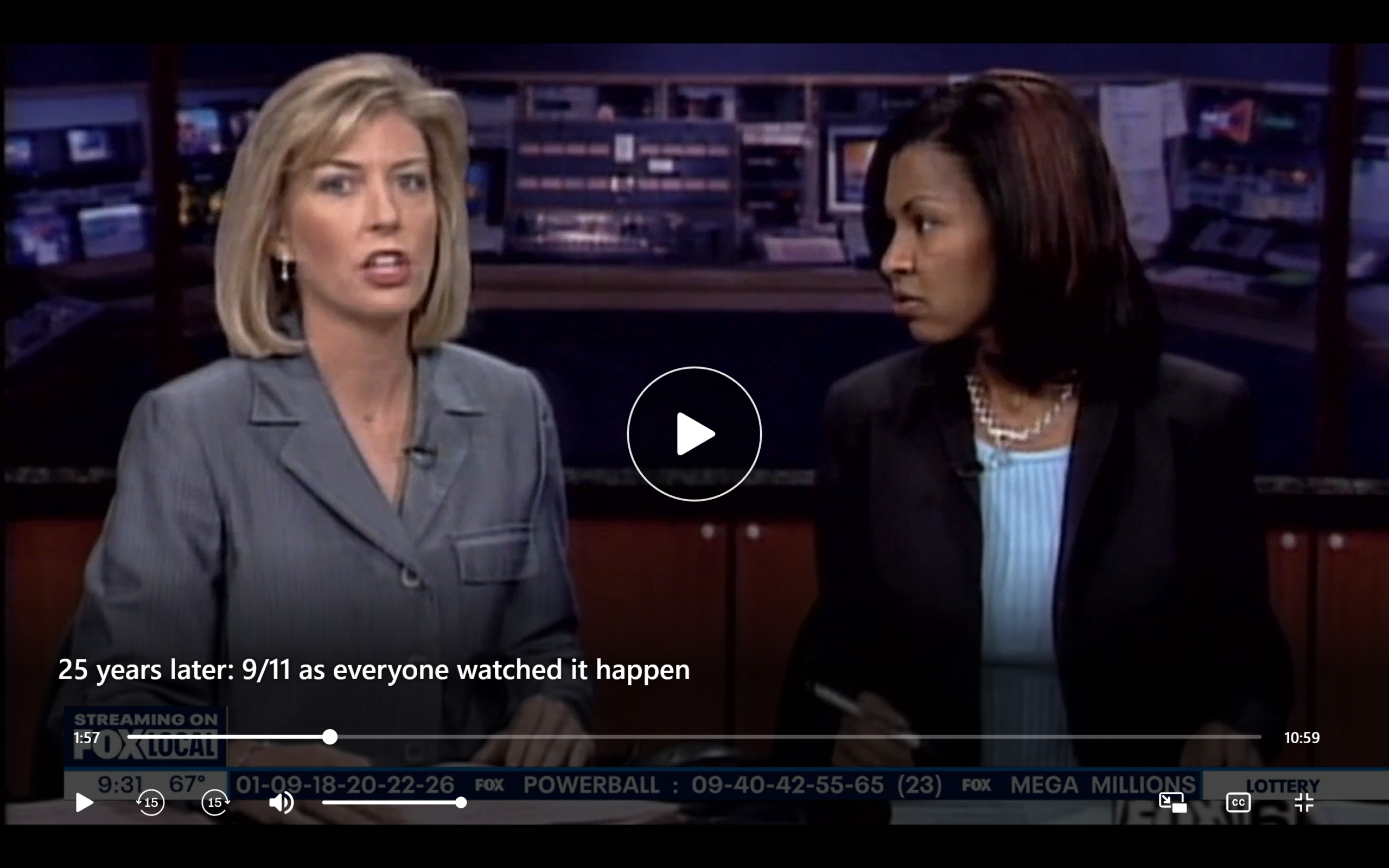
Hard to believe twenty-five years have passed. FOX6 recently brought several of us back together to reflect on what it was like to cover September 11, 2001, and watching that story brought back memories that still feel remarkably close despite the years that have passed.
That morning, I was filling in on the anchor desk alongside Kim Murphy. It had started as a beautiful September day in Milwaukee, and we were nearing the end of what should have been an ordinary morning newscast when the first reports began coming across the wires about a plane hitting the World Trade Center.
At first, like so many people watching from across the country, we were trying to understand what we were seeing.
Then the second plane hit, and suddenly we understood enough to know that nothing about this morning was ordinary anymore.
The newsroom began filling with people. The story grew larger and more horrifying by the minute. Kim was eventually sent into the field, while I remained behind the anchor desk knowing that at any moment the network could send coverage back to us and I would have to be ready to speak clearly, and be professional about something none of us could fully comprehend.
During one stretch of national coverage, I picked up the landline underneath the anchor desk and called my mother in California.
She asked me if I was okay.
I was honest and said, “I am not okay.” And I wasn’t – emotionally. People were jumping from windows.
One part of that morning wasn’t included in the recent FOX6 story, and in many ways it is the part I think about most now that I spend my career teaching leaders how to communicate under pressure.
After I got off the phone with my mother, I was super emotional. Tears were welling up in my eyes, and I knew I was about to start crying.
We were all watching something horrific unfold in real time, but I was responsible for staying calm and helping others understand what they were seeing. I was a journalist, and I had to quickly figure out how to be a professional in a moment when people needed me to keep it together.
Over my microphone, I told our producer, Kelly Stoop, back in the control room exactly what I needed.
The way I remember it, I said, “Kelly, you have to start yelling at me and stop me from crying. I need to get mad.”
What I remember her saying back was:
“Okay, bitch, let’s do this!”
And it worked.
Not because Kelly made me stop caring. Not because the situation became any less tragic. She jolted me out of one emotional state and into another that let me function.
For those few critical moments, sadness was replaced by anger, and anger gave me something sadness wasn’t giving me then: focus.
Twenty-five years ago, I would not have had the language to explain what happened between us in that newsroom.
Today, I do.
Kelly helped me flip a switch.
And that experience taught me something I now teach leaders all the time: when adrenaline and emotion take over in a high-stakes communication moment, the goal is not necessarily to become perfectly calm. The goal is to recognize what is happening in your body, regulate what you can, redirect the energy you already have, interrupt the habits that weaken your communication, and refocus on what your audience needs from you.
That is a very different skill from simply telling yourself to “calm down.”
It is executive presence in action.
How Do You Communicate Effectively When Your Emotions Take Over?
We often talk about executive presence as though certain people simply possess an extraordinary ability to remain calm no matter what happens around them.
After years in television news and years coaching leaders, I don’t believe that is what is actually happening.
Strong communicators feel pressure.
Their hearts race. Their breathing changes. Their minds move faster. They experience fear, uncertainty, sadness, frustration, and sometimes several of those emotions at once.
The difference is that they learn to recognize what is happening internally without automatically allowing that first emotional response to dictate what happens externally.
That does not mean pretending not to feel.
It means learning how to stay intentional while you are feeling.
That distinction matters because executive presence is not the absence of emotion. It is the ability to manage your internal state well enough to serve the people who are relying on you.
On September 11, Kelly could not make me stop feeling the enormity of what was happening, nor would I have wanted her to. I asked her to simply interrupt my emotional state that was making it difficult for me to do my job as a journalist.
Leaders face versions of this challenge every day, even if the circumstances are thankfully far less extraordinary.
- A difficult board meeting.
- An unexpected question from a reporter.
- A presentation to investors.
- A high-stakes client conversation.
- A restructuring announcement.
- A room full of employees looking to you for confidence when you don’t have every answer yet.
In those moments, the question is not, “Can I make myself feel nothing?”
The better question is, “Can I choose what I do next?”
Your Power Source Comes Before Your Performance
The first part of my Charisma Switch framework is what I call your Power Source, which is the internal energy, confidence, intentionality, and preparation you bring into a communication moment.
Most people approach communication from the outside in. They worry about their slides, their talking points, where they will stand, whether they will remember everything and whether they will sound intelligent enough.
All of those things matter, but your audience is processing something else at the same time.
They are reading your energy.
They are deciding whether you seem confident, credible, present, and trustworthy, and they often begin making those judgments before they could repeat back a single sentence you said.
That becomes even more important under pressure because your nervous system may be doing something entirely different from what your audience needs from you.
When your brain perceives a threat, the body’s stress response begins preparing you for action. Adrenaline and other stress hormones can increase heart rate, alter breathing, sharpen attention, and flood the body with energy.
That response is incredibly useful when you are facing a genuine physical danger.
It becomes more complicated when the “threat” is a television camera, an unexpected question, a board presentation, or a room waiting for you to explain what happens next.
Your body may be signaling, “Danger,” while your leadership role requires you to communicate, “I am present, I am thinking clearly, and I can guide us through this.”
That is why I don’t believe the goal should always be to eliminate adrenaline.
Sometimes you need to learn how to use it.
How Do You Control Adrenaline and Nerves Before You Speak?
This is where the story with Kelly has become even more interesting to me over the years.
Research into performance anxiety has found that trying to force yourself from a highly activated state into complete calm may not always be the easiest path. Anxiety and excitement, for example, are both high-arousal states, which means it can sometimes be more effective to reinterpret or redirect the energy than to try to erase it altogether.
Kelly certainly did not move me from devastated to serene.
She moved me from devastated to anger.
I am not suggesting that leaders start asking their colleagues to insult them before important meetings.
But a powerful lesson lies beneath what happened.
Sometimes you don’t need to shut the energy down. You need to give it somewhere useful to go.
You might tell yourself, “This isn’t panic. This is energy because this moment matters.”
You might decide, “My heart is racing, but I know exactly what I want this audience to understand.”
Or perhaps your entire assignment becomes, “Slow down and deliver the next sentence.”
That is Power Source in action. You recognize the energy, decide what meaning you are going to give it, and then choose how you want to use it.
This is where strong leaders separate themselves.
They don’t wait for their emotions to become perfectly convenient before they communicate. They learn how to work with the energy that is already there.
The Fastest Way Out of Your Head Is Into Your Audience
I had another shift to make that morning, and it is one I teach leaders constantly today.
When we become nervous, our attention tends to move inward.
- How do I look?
- Can they tell I’m nervous?
- What if I forget something?
- What if my voice shakes?
- What if I get emotional?
- What if I say the wrong thing?
- What if I lose my place?
Our focus turns toward ourselves at precisely the moment when strong communication requires us to focus on someone else.
That is why another part of the Charisma Switch is Amp the Audience.
Great communication starts with understanding what the audience cares about, fears, needs, and will trust.
The real question is not, “How do I make myself look composed?”
The real question is: What does this audience need from me right now?
On September 11, the people watching FOX6 did not need me to behave as though nothing terrible was happening. That would have been completely inappropriate and inauthentic.
They also did not need me to collapse under the weight of what we were all witnessing.
They needed information. They needed clarity. They needed context. They needed someone who could keep listening, processing, and communicating while events changed by the minute.
The same principle applies in a boardroom, during a media interview, or in a difficult employee conversation.
Your audience may need confidence.
They may need reassurance.
They may need candor.
They may need urgency.
They may need empathy.
They may need you to slow down and make something complicated understandable.
That is why one of the most useful questions a leader can ask before speaking is:
Who does my audience need me to be in this moment?
Notice that I did not say, “Who do I need to pretend to be?”
This is not about becoming someone artificial.
It is about accessing the part of yourself that best serves the room you are in.
When you make that shift, your attention moves away from your own nerves, and toward the people you are there to serve.
That is where communication moves from information to influence.
Can Breathing Techniques Help You Communicate Under Pressure?
Sometimes, changing your thoughts isn’t enough because your body’s stress response has already taken over.
That is where your breath becomes one of your most practical tools.
When we are under pressure, breathing often becomes faster and shallower without us even noticing. Because breathing is one of the physical processes we can deliberately influence, it gives us a way to interrupt that automatic reaction.
One technique many people find helpful is box breathing.
You inhale slowly for four counts, hold for four, exhale for four, and hold again for four before repeating the cycle.
The number four isn’t magical. What matters is that you took something your body did automatically and made it intentional.
Another approach is to make the exhale slightly longer than the inhale. You might breathe in gently for four counts and exhale for six, without forcing either part of the breath.
Research into slow and controlled breathing continues to evolve, but studies have found that breathing practices can influence physiological arousal and aspects of autonomic regulation, and research comparing several breathwork techniques has also shown promising results from practices that emphasize a longer exhale.
The leadership lesson is practical:
Sometimes you cannot think your way out of a stress response while your body is still telling your brain something is wrong.
So start with the body.
- Slow your breathing.
- Release your jaw.
- Lift up and hold your shoulders and then drop them down.
- Feel both feet on the floor.
Then decide what your audience needs to hear.
People read your energy before they process your words, which means managing your physical state isn’t separate from communication.
It is part of communication.
Find Your Circuit Breaker Before the Pressure Hits
Another important part of the Charisma Switch is what I call the Circuit Breaker, because almost every communicator has a habit that appears when pressure rises and weakens the message.
- Maybe you speak faster.
- Maybe your voice gets higher.
- Maybe filler words suddenly multiply.
- Maybe you start talking in circles because silence feels uncomfortable.
- Maybe your shoulders creep toward your ears and your physical presence gets smaller.
- Maybe you stop breathing at the ends of sentences.
- Maybe your opening gets weaker because you rush through it.
The important thing is to identify your pattern before the most important communication moment of your career.
Once you know your Circuit Breaker, you can create an intentional interruption.
If you rush, deliberately slow your first sentence.
If you ramble, identify the single idea you want the audience to remember before you begin.
If your breathing becomes shallow, take one intentional breath before answering.
If you fill silence, practice allowing the pause to do some of the work for you.
If you tend to lose your message under pressure, return to one clear sentence: “What does this audience absolutely need to understand?”
You don’t need fifteen complicated techniques when adrenaline is already flowing.
You need one reliable Circuit Breaker that reminds your brain and body, “I know what to do here.”
Give Yourself a Job, Not an Emotion
One of the simplest tools I give leaders is to assign themselves a job before entering a high-pressure communication moment.
Don’t tell yourself how you are supposed to feel.
Give yourself something to do.
Instead of saying, “I need to stop being nervous,” tell yourself, “I need to make this clear.”
Instead of “I can’t look anxious,” try “I need to create confidence for everyone in this room.”
Your assignment might be to listen carefully, slow the conversation down, make a difficult decision understandable, or become the steady voice people can trust.
This works for a deceptively simple reason. “Don’t be nervous” gives your brain almost nowhere to go. “Create clarity” gives it a job.
On September 11, my assignment eventually became very simple: be ready to anchor, listen carefully, process the information, tell people what we know, and do the job.
Not because I stopped feeling the enormity of what was happening.
I didn’t.
But journalism required me to carry those emotions without asking the audience to carry them for me.
Leadership often requires the same thing.
Maximum Voltage Doesn’t Mean Maximum Volume
The final part of my Charisma Switch framework is Maximum Voltage, and this is where I think many people misunderstand charisma.
Charisma is not always bigger.
It is not necessarily louder, more energetic, or more animated.
Maximum Voltage happens when your message, presence, delivery, and energy align with what the audience and the moment require.
- Sometimes that means inspiring a ballroom full of people.
- Sometimes it means confidently defending an idea in a boardroom.
- Sometimes it means looking directly into a camera during a crisis and choosing every word with enormous care.
- Sometimes it means saying less, not more.
And sometimes, as it did for me twenty-five years ago, it means finding a way to regain enough control over your emotions to communicate through one of the darkest mornings our country has ever experienced.
That experience changed the way I understand communication.
The goal is not to become a polished, emotionless version of yourself when the stakes rise.
The goal is to become more intentional about which part of yourself the moment requires.
- You may need more energy.
- You may need more calm.
- You may need more authority.
- You may need more empathy.
You may simply need enough control over your own nervous system to make the next good decision.
The Skill Is Learning How to Find Your Way Back
That morning, Kelly Stoop helped me do something I didn’t yet know how to name.
She changed my emotional state so I could change my focus.
Today, I teach leaders to build the ability to do that for themselves.
You practice your Power Source before the presentation.
You understand and Amp Your Audience before you walk into the room.
You identify your Circuit Breaker before pressure exposes it.
You use your breath and your body to regulate the energy when necessary.
And then you bring the message, presence, delivery, and intention together so your audience experiences what I call Maximum Voltage.
Because high-stakes communication will eventually test all of us.
The circumstances will almost certainly not look like that morning in September, but there will be moments when the room changes, when the question you weren’t expecting gets asked, when your emotions arrive before your words do, or when people look to you because you’re the leader and they want to know what happens next.
In those moments, the goal isn’t to become someone else.
It is to know yourself well enough, and to understand your audience clearly enough, that you can access the version of yourself the moment requires.
That is what executive presence looks like under pressure. You won’t always be perfect. I wasn’t. But with practice, you’ll give your audience the leadership they deserve.